Last updated: April 2026
Quick Answer (Featured Snippet Optimised)
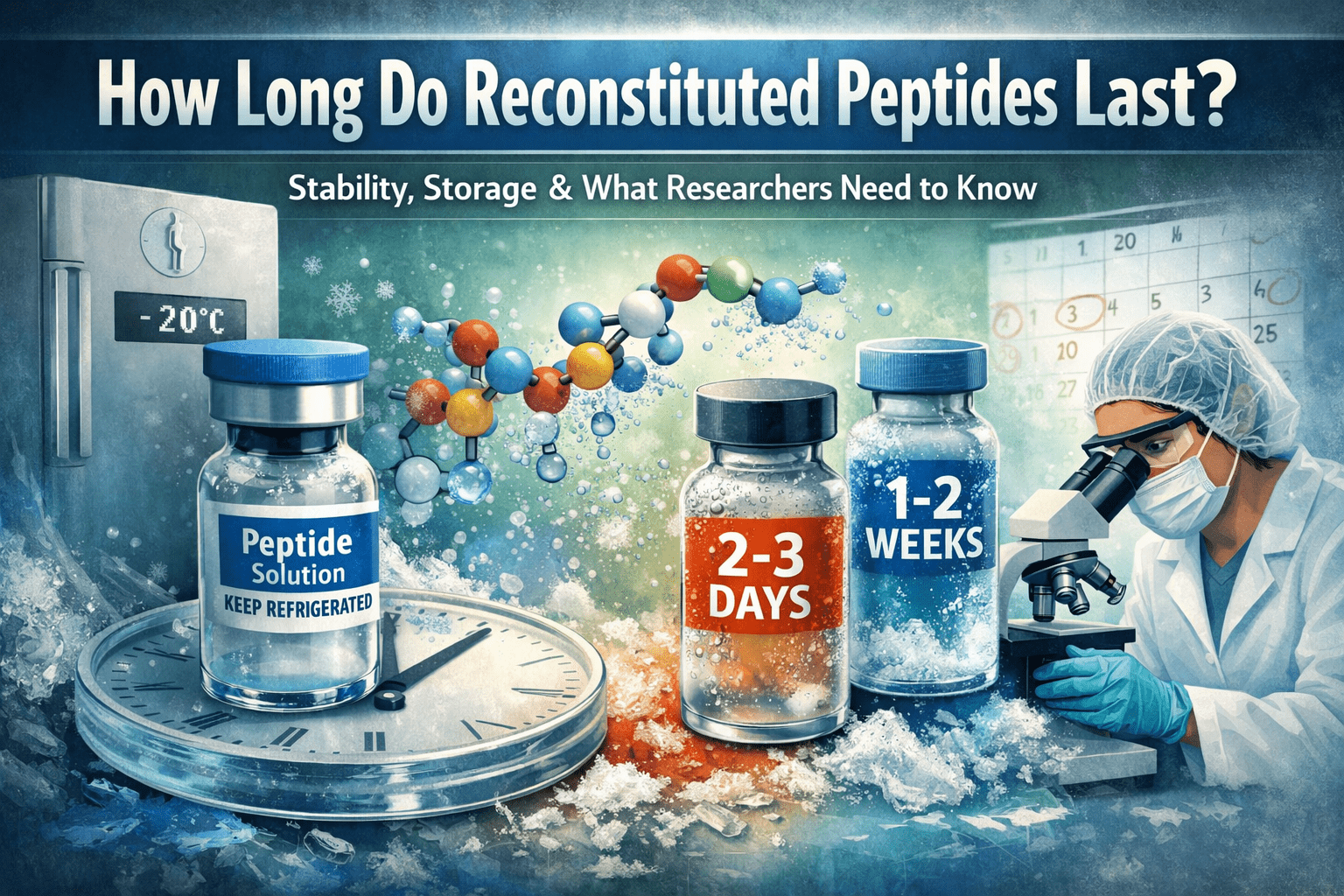
Reconstituted peptides typically last 7–14 days when mixed with sterile water and up to 21–30 days when mixed with bacteriostatic (BAC) water and stored in a refrigerator (2–8°C).
Their stability depends on the peptide type, storage conditions, and handling practices.
What Happens After Peptides Are Reconstituted?
Once a peptide is mixed with liquid, it becomes significantly less stable than in its lyophilised (powder) form.
This is due to natural chemical processes such as:
- Hydrolysis – water breaking peptide bonds
- Oxidation – exposure to oxygen altering structure
- Aggregation – peptides clumping together
These degradation pathways are well documented in peptide chemistry and protein stability research, particularly in aqueous environments where molecular bonds are more exposed.
Typical Stability of Reconstituted Peptides
| Storage Condition | Estimated Stability |
|---|---|
| Room temperature | Hours to a few days |
| Refrigerated (sterile water) | ~7–14 days |
| Refrigerated (BAC water) | ~21–30 days |
| Frozen (-20°C) | Weeks to months (if handled correctly) |
⚠️ These are general guidelines — actual stability varies by peptide and handling.
Stability by Common Peptides
| Peptide | Typical Stability (Refrigerated, BAC Water) |
|---|---|
| BPC-157 | ~30 days |
| TB-500 | ~21–30 days |
| CJC-1295 | ~20–30 days |
| Ipamorelin | ~21–28 days |
⚠️ Stability varies depending on purity, formulation, and handling conditions.
BAC Water vs Sterile Water (Key Differences)
| Feature | BAC Water | Sterile Water |
|---|---|---|
| Contains preservative | Yes (benzyl alcohol) | No |
| Shelf life | Longer | Shorter |
| Contamination risk | Lower | Higher |
Bacteriostatic water contains benzyl alcohol, which inhibits microbial growth — a factor widely recognised in pharmaceutical preparation and sterile compounding practices.
Fridge vs Freezer: Which Is Better?
Refrigeration (2–8°C)
- Most common storage method
- Slows degradation effectively
- Ideal for short-term use
Freezing (-20°C or lower)
- Can extend lifespan significantly
- Requires careful handling
Repeated freeze-thaw cycles can cause structural stress and denaturation, a known issue in peptide and protein storage.
Best practice: store in small aliquots if freezing.
Common Mistakes That Reduce Peptide Stability
Even properly reconstituted peptides can degrade quickly if mishandled.
Avoid:
- Leaving peptides at room temperature for extended periods
- Using non-sterile syringes or equipment
- Repeatedly opening vials (introducing contaminants)
- Exposure to light and air
- Multiple freeze-thaw cycles
What Determines How Long Peptides Last After Reconstitution?
Several factors influence stability:
1. Temperature
Lower temperatures slow chemical degradation significantly by reducing reaction rates.
2. Diluent Type
BAC water extends usability compared to sterile water due to antimicrobial properties and reduced contamination risk.
3. Peptide Structure
Stability varies depending on amino acid composition and susceptibility to hydrolysis and oxidation.
4. Handling & Sterility
Contamination is one of the fastest ways to reduce peptide lifespan, particularly in multi-use vials.
5. Environmental Exposure
Light, oxygen, and repeated handling accelerate degradation processes.
After Reconstitution: What Changes?
After mixing, peptides are in an aqueous environment where:
- Molecular bonds are more exposed
- Chemical reactions occur more readily
- Stability becomes time-dependent
This is consistent with established principles of peptide chemistry, where aqueous solutions accelerate degradation compared to dry (lyophilised) states.
Related Guides in This Hub
- Peptide reconstitution guide
- Peptide storage best practices
- BAC water vs sterile water explained
👉 This article is part of our Reconstitution & Stability Hub, where we cover peptide handling and storage in detail.
FAQs
How long do peptides last after reconstitution in the fridge?
Typically 1–4 weeks, depending on whether BAC or sterile water is used and how well the peptide is handled.
Can you freeze reconstituted peptides?
Yes, but stability varies. Avoid repeated freeze-thaw cycles, which can degrade peptide structure.
Do peptides expire faster without BAC water?
Yes. Without preservatives, contamination risk increases and shelf life is usually shorter.
How do you know if a peptide has degraded?
Degradation is usually not visible. It occurs at a molecular level and may result in reduced effectiveness or inconsistent results.
Can peptides last longer than 30 days?
Some may under ideal conditions, but most guidelines recommend using within 2–4 weeks after reconstitution.
Final Takeaway
Reconstituted peptides are inherently less stable than their powdered form.
While 21–30 days is a common guideline under refrigeration with BAC water, real-world stability depends on:
- Storage conditions
- Handling practices
- The peptide itself
Maintaining proper technique and controlled storage is essential for consistency in research applications.