Introduction
When storing peptides after reconstitution, one of the most common questions is whether freezing or refrigeration is the better option.
Both approaches aim to slow degradation, but they work in very different ways—and introduce different risks. While freezing may seem like the more powerful preservation method, it is not always the most reliable choice in practice.
Understanding how each method affects peptide stability is key to making the right decision for your research.
Why Storage Matters After Reconstitution
Peptides are highly stable in their lyophilised form, but once reconstituted, they enter a more fragile state.
In solution, they are exposed to:
- Hydrolysis
- Oxidation
- Structural instability over time
Storage conditions determine how quickly these processes occur, and ultimately how reliable the peptide remains during use.
Refrigeration: The Standard Approach
Refrigeration is the most widely used storage method for reconstituted peptides.
By lowering temperature, it slows down chemical reactions that lead to degradation. Importantly, it does this without introducing significant physical stress to the peptide structure.
For most research applications, refrigeration provides a balance between stability and predictability.
Advantages of Refrigeration
Refrigeration is generally preferred because it:
- Slows degradation without altering structure
- Maintains a stable environment
- Avoids mechanical stress from ice formation
It is particularly well suited for short-term storage and consistent day-to-day use.
Limitations of Refrigeration
While effective, refrigeration does not stop degradation entirely.
Over time, peptides will still:
- Lose activity
- Undergo structural changes
- Become less reliable
This is why limiting time in solution remains important.
👉 See: How Long Do Reconstituted Peptides Last
Freezing: A More Complex Option
Freezing takes temperature reduction further, slowing molecular motion to a greater extent. In theory, this should extend peptide stability.
In practice, freezing introduces additional variables that can affect peptide integrity.
Advantages of Freezing
Freezing can:
- Further slow chemical degradation
- Be useful for long-term storage in controlled conditions
- Allow aliquoting strategies to reduce repeated use
When used correctly, it can be part of a structured storage approach.
Risks of Freezing
Unlike refrigeration, freezing is not a passive process.
As water freezes, ice crystals form and solutes become concentrated in the remaining liquid phase. This can:
- Alter pH and local conditions
- Introduce mechanical stress
- Promote aggregation
Repeated freeze–thaw cycles amplify these effects and are one of the main causes of peptide instability.
The Key Difference
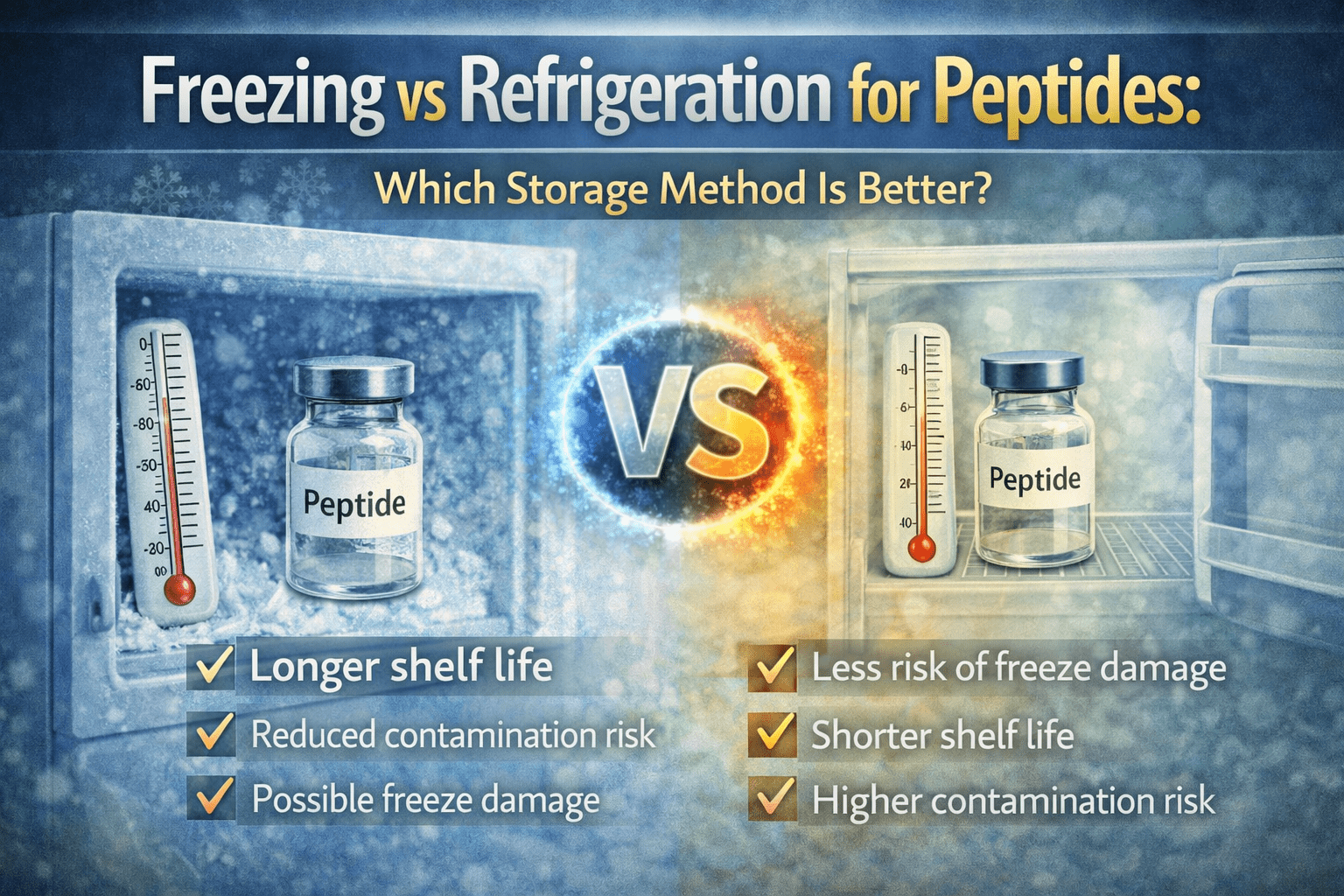
The difference between refrigeration and freezing comes down to predictability vs potential longevity.
Refrigeration offers a stable, low-risk environment with gradual degradation.
Freezing offers slower chemical breakdown but introduces physical and chemical stresses that can affect structure—especially if not carefully controlled.
When to Use Refrigeration
Refrigeration is generally the preferred option when:
- Peptides will be used within a short timeframe
- Consistency and reliability are priorities
- Repeated handling is expected
This is the default approach for most research scenarios.
When Freezing May Be Used
Freezing may be considered when:
- Long-term storage is required
- Peptides are aliquoted to avoid repeated thawing
- Conditions are carefully controlled
Even then, it is typically used with caution rather than as a default.
Peptide Sensitivity Matters
Not all peptides respond the same way to storage conditions.
Larger or more complex peptides tend to be more sensitive to freezing stress. Compounds such as tesamorelin or IGF-1 variants may be more prone to structural changes compared to smaller peptides.
Because of this, storage decisions should always consider the specific peptide being used.
Practical Takeaway for Researchers
For most research applications, refrigeration is the more reliable and consistent option.
Freezing can be useful in specific scenarios, but it introduces additional risks that need to be carefully managed. Without proper control, it may do more harm than good.
In both cases, the most important factor remains the same: minimise time in solution and maintain consistent handling practices.
🔬 Why Peptide Quality Still Matters
Storage conditions influence stability, but they start with the quality of the peptide itself.
High-quality peptides:
- Are more structurally consistent
- Respond more predictably to storage
- Produce more reliable results
At DL Peptides, all compounds are supplied in lyophilised form and batch-tested to support consistent research outcomes.
👉 Explore Research-Grade Peptides
If your research depends on peptide stability, both handling and sourcing play a role.
- 👉 View Tesamorelin (Research Use Only)
- 👉 Explore CJC-1295, Ipamorelin & IGF-1
- 👉 Browse the full D&L Peptides catalogue
Final Thoughts
Freezing and refrigeration both have a place in peptide storage, but they are not interchangeable.
Refrigeration offers simplicity and consistency, making it the preferred choice for most applications. Freezing can extend stability under the right conditions, but it introduces additional variables that must be carefully controlled.
For many researchers, the most effective approach is not choosing the most aggressive method—but the most predictable one.
Frequently Asked Questions
Is freezing better than refrigeration for peptides?
Not necessarily. Freezing slows degradation more but introduces structural stress, while refrigeration provides more consistent stability.
Should peptides be refrigerated after reconstitution?
Yes. Refrigeration is the most commonly used method for short-term storage.
Can freezing damage peptides?
Yes. Ice crystal formation and freeze–thaw cycles can affect peptide structure and activity.
When should peptides be frozen?
Freezing may be used for long-term storage if peptides are aliquoted and freeze–thaw cycles are avoided.
Do all peptides respond the same to storage?
No. Stability depends on peptide size, structure, and sensitivity to environmental stress.
References
- Wang, W. (2000). Lyophilization and development of solid protein pharmaceuticals. International Journal of Pharmaceutics.
- Carpenter, J. F., & Crowe, J. H. (1988). The mechanism of cryoprotection of proteins by solutes. Cryobiology.
- Chang, B. S., & Randall, C. S. (1992). Use of subambient thermal analysis to optimize protein lyophilization. Pharmaceutical Research.