Introduction
Peptides are often assumed to remain stable as long as they are stored correctly, but degradation is an ongoing process—especially after reconstitution.
In many cases, degradation does not present obvious visual changes. Instead, it shows up subtly, through reduced activity or inconsistent results. This makes it easy to overlook, and in turn, easy to misattribute to experimental variables rather than peptide stability.
Recognising the signs of degradation is essential for maintaining data quality and avoiding false conclusions.
Why Peptides Degrade
Once a peptide is reconstituted, it becomes chemically active in an aqueous environment.
At this point, several degradation pathways begin to occur, including:
- Hydrolysis of peptide bonds
- Oxidation of susceptible amino acid residues
- Aggregation and structural rearrangement
These processes are influenced by temperature, pH, light exposure, and solvent conditions, and are well documented in peptide formulation studies (Cleland et al., 1993).
Even under controlled storage conditions, degradation cannot be fully prevented—only slowed.
Visible Signs of Degradation
In some cases, peptide degradation can be identified through physical changes in the solution.
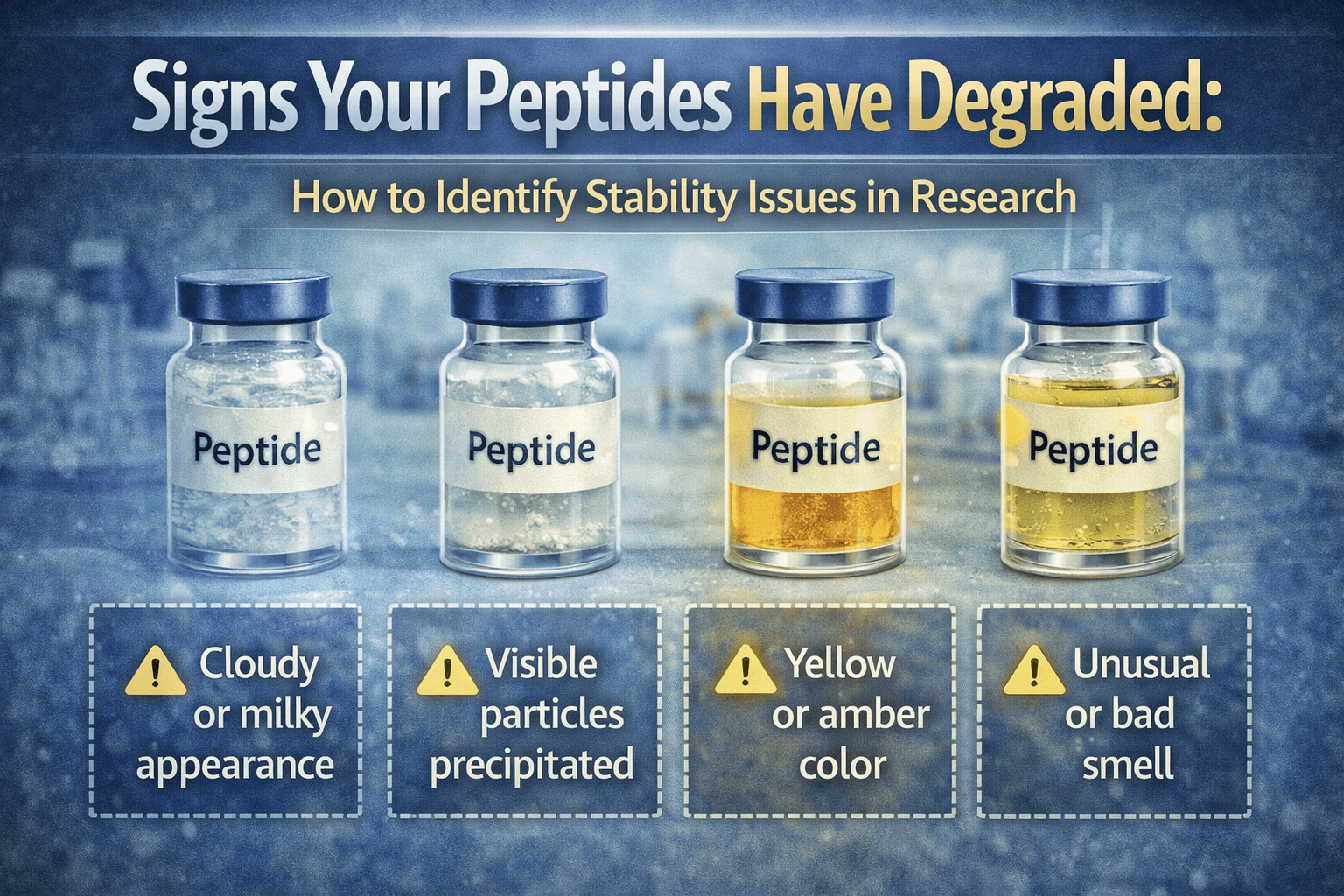
A properly reconstituted peptide should appear clear and uniform. Any deviation from this can indicate instability.
Cloudiness is often associated with aggregation or insoluble peptide fragments. The presence of visible particles or sediment suggests that the peptide is no longer fully dissolved or structurally intact.
In more advanced cases, changes in viscosity or a slightly gel-like appearance may indicate intermolecular interactions or aggregation, particularly in peptides prone to self-association.
Loss of Biological Activity
The most reliable indicator of peptide degradation is not visual—it is functional.
A peptide that has degraded may:
- Produce weaker-than-expected responses
- Show inconsistent results across experiments
- Lose activity entirely
These changes often occur before any visible signs appear, making them more difficult to detect without careful control of variables.
Studies on peptide therapeutics have shown that even minor structural modifications can significantly alter biological activity (Brange et al., 1997).
Time-Dependent Degradation
Time is one of the most significant factors affecting peptide stability.
Once reconstituted, peptides exist in a state of gradual decline. Chemical reactions continue at a rate determined by environmental conditions, leading to cumulative structural changes over time.
Even if a peptide appears stable initially, its activity may decrease as degradation progresses. This is why extended storage after reconstitution is a common source of variability in research.
See: How Long Do Reconstituted Peptides Last
Storage Conditions and Their Impact
Storage plays a major role in how quickly degradation occurs.
Elevated temperatures increase molecular motion and accelerate chemical reactions. Light exposure can promote oxidation, particularly in peptides containing sensitive residues such as methionine or tryptophan.
Repeated temperature fluctuations—such as moving between refrigeration and room temperature—can introduce additional stress, affecting both chemical stability and solubility.
Freezing adds another layer of complexity, as ice formation and freeze concentration can alter peptide structure.
👉 See also:
Reconstitution-Related Instability
Degradation does not always begin during storage—it can start during reconstitution.
Rapid solvent addition, agitation, or improper mixing can introduce mechanical stress and promote aggregation. In some cases, peptides may partially unfold or form aggregates immediately after reconstitution, even if the solution appears clear.
Maintaining a controlled and gentle reconstitution process helps reduce these risks.
See: Peptide Reconstitution Guide (Step-by-Step)
Why Some Peptides Are More Vulnerable
Peptide stability is highly dependent on molecular structure.
Peptides containing oxidation-prone residues, flexible conformations, or sequences that promote self-association are more susceptible to degradation. Larger peptides and those with biological activity dependent on precise structure tend to be more sensitive.
For example, endocrine-related peptides and growth factor analogues often require tighter handling conditions than smaller, simpler peptides.
This variability highlights the importance of treating each peptide individually rather than applying a single storage assumption across all compounds.
When a Peptide Should Not Be Used
If degradation is suspected, the safest approach is to avoid using the peptide.
Clear visual indicators such as cloudiness or particles are strong signals. However, even in the absence of visible changes, a noticeable drop in expected activity should be taken seriously.
Using degraded peptides can compromise data integrity and lead to incorrect conclusions.
Why Peptide Quality Still Matters
Handling and storage influence stability, but they start with the quality of the peptide itself.
High-purity peptides produced under controlled conditions are more resistant to degradation and behave more predictably during use. Lower-quality materials may degrade more rapidly or inconsistently.
At DL Peptides, all compounds are supplied in lyophilised form and tested to ensure consistency across research applications.
Explore Research-Grade Peptides
If your research depends on reliable peptide performance, both sourcing and handling matter.
- View Tesamorelin (Research Use Only)
- Explore CJC-1295, Ipamorelin & IGF-1
- Browse the full D&L Peptides catalogue
Final Thoughts
Peptide degradation is often subtle, but it has a direct impact on research outcomes.
Visible changes can provide clear warnings, but more often, degradation reveals itself through reduced or inconsistent activity. Understanding both types of signals allows researchers to identify problems early and maintain experimental reliability.
In most cases, the best approach is proactive: control handling, limit time in solution, and monitor for change.
Frequently Asked Questions
How can you tell if peptides have degraded?
Signs include cloudiness, visible particles, changes in consistency, or reduced biological activity.
Can peptides degrade without visible changes?
Yes. Many degradation processes occur at a molecular level and only become apparent through reduced performance.
What causes peptide degradation?
Common causes include hydrolysis, oxidation, aggregation, temperature exposure, and improper handling.
Should degraded peptides be used?
No. Degraded peptides can produce unreliable and inconsistent results.
Do all peptides degrade at the same rate?
No. Stability depends on peptide structure, sequence, and environmental conditions.
References
- Cleland, J. L., Powell, M. F., & Shire, S. J. (1993). The development of stable protein formulations: a review of protein stabilization techniques. Critical Reviews in Therapeutic Drug Carrier Systems.
- Brange, J., Langkjær, L., Havelund, S., & Vølund, A. (1997). Chemical stability of insulin. Pharmaceutical Biotechnology.
- signs-peptides-have-degraded