Introduction
Not all peptide results are created equal—and one of the most overlooked variables is peptide freshness.
Two experiments using the same compound can produce completely different outcomes depending on whether the peptide is fresh or degraded. The challenge is that degradation isn’t always obvious. A peptide may look normal, yet behave very differently.
Understanding the difference between fresh and degraded peptides is essential for maintaining consistency and avoiding misleading results.
What Defines a “Fresh” Peptide?
A fresh peptide is one that retains its intended structure and biological activity.
In practical terms, this usually means:
- Recently reconstituted or within its stable window
- Properly stored under controlled conditions
- Free from contamination or structural alteration
Fresh peptides behave predictably, producing consistent responses in research settings.
What Defines a “Degraded” Peptide?
A degraded peptide has undergone chemical or physical changes that affect its structure.
These changes may include:
- Breakdown of peptide bonds (hydrolysis)
- Oxidation of sensitive residues
- Aggregation or misfolding
Importantly, degradation exists on a spectrum. A peptide does not need to be completely inactive to be considered degraded—even partial changes can affect results.
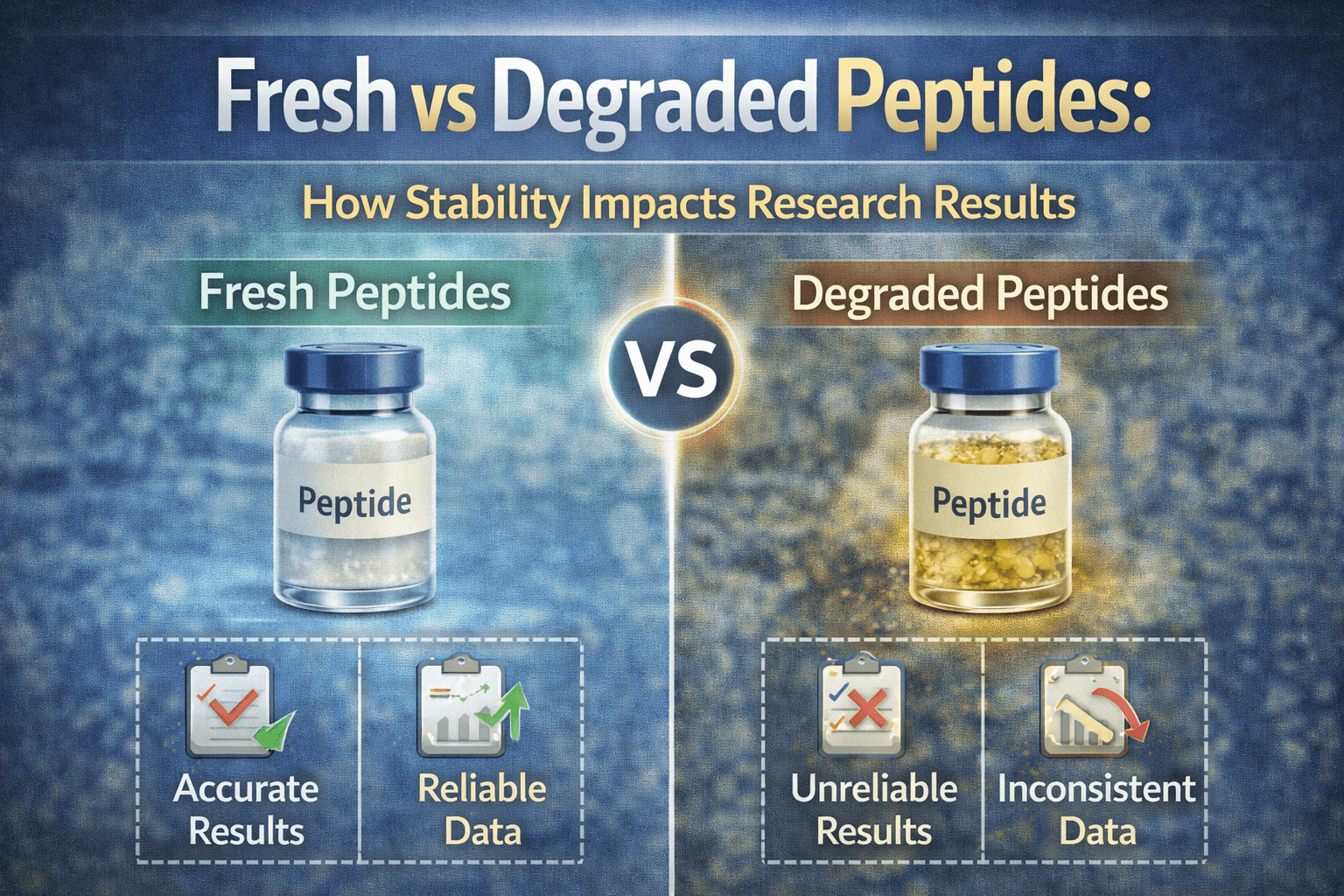
Side-by-Side Comparison
| Feature | Fresh Peptides | Degraded Peptides |
|---|---|---|
| Appearance | Clear, consistent | May be cloudy or unchanged |
| Structure | Intact | Altered or partially damaged |
| Activity | Predictable | Reduced or inconsistent |
| Stability | Within usable window | Past optimal stability |
| Research Results | Reproducible | Variable or unreliable |
Why Degradation Matters in Research
Peptide degradation doesn’t just reduce effectiveness—it introduces variability.
This can lead to:
- Inconsistent results between experiments
- False negatives or reduced responses
- Misinterpretation of compound performance
In many cases, what appears to be experimental error is actually a stability issue.
The Hidden Problem: Degradation Without Visible Signs
One of the biggest challenges is that degraded peptides often look normal.
A solution can remain clear and free of particles while still experiencing:
- Reduced potency
- Altered receptor interaction
- Slower or weaker responses
This makes it difficult to detect degradation without controlling for time, storage, and handling conditions.
👉 See: Signs Your Peptides Have Degraded
How Peptides Become Degraded
Degradation begins as soon as a peptide is reconstituted.
Common contributing factors include:
- Time in solution
- Exposure to heat or light
- Improper storage conditions
- Repeated freeze–thaw cycles
- Mechanical stress during reconstitution
Each of these factors accelerates structural change, even if the effects are not immediately visible.
👉 See also:
Real-World Impact on Results
In practical research scenarios, degraded peptides often lead to subtle but important differences.
You may see:
- Lower-than-expected activity
- Increased variability between trials
- Inconsistent dose-response relationships
These effects can compromise the reliability of your data, especially in sensitive pathways like GH/IGF-1 research.
How to Maintain Peptide Freshness
While degradation cannot be completely avoided, it can be managed.
Key principles include:
- Reconstitute peptides carefully and consistently
- Store under controlled conditions
- Minimise time in solution
- Avoid repeated temperature changes
Using peptides within their effective window is one of the most reliable ways to maintain consistency.
🔬 Why Starting Quality Still Matters
Even with perfect handling, peptide quality plays a major role in stability.
High-purity peptides:
- Maintain structure more reliably
- Degrade more predictably
- Produce more consistent results
Lower-quality peptides may degrade faster or behave inconsistently from the start.
At DL Peptides, all compounds are supplied in lyophilised form and batch-tested to ensure consistency across research applications.
👉 Work With Reliable Peptides
If your research depends on consistency, both handling and sourcing matter.
- 👉 View Tesamorelin (Research Use Only)
- 👉 Explore CJC-1295, Ipamorelin & IGF-1
- 👉 Browse the full D&L Peptides catalogue
Quick Checklist: Fresh vs Degraded
Fresh peptide indicators:
- Clear, stable solution
- Consistent results across experiments
- Recently prepared and properly stored
Degraded peptide indicators:
- Reduced or inconsistent activity
- Unexpected variability
- Visible changes (in some cases)
Final Thoughts
The difference between fresh and degraded peptides is not always visible—but it is always significant.
For researchers, this distinction can determine whether results are reliable or misleading. By understanding how degradation occurs and how to recognise it, you can reduce variability and improve the quality of your data.
In most cases, fresher peptides lead to more consistent outcomes.
Frequently Asked Questions
What is the difference between fresh and degraded peptides?
Fresh peptides retain their structure and activity, while degraded peptides have undergone changes that reduce stability and effectiveness.
Can degraded peptides still work?
They may still produce effects, but results are often weaker or inconsistent.
How quickly do peptides degrade?
Degradation begins after reconstitution and progresses over time depending on storage and handling.
Can peptides look normal but be degraded?
Yes. Many peptides degrade without visible changes, with reduced activity being the main indicator.
How can degradation be avoided?
By controlling reconstitution, storage, and time in solution, degradation can be minimised.
References
- Frokjaer, S., & Otzen, D. E. (2005). Protein drug stability: a formulation challenge. Nature Reviews Drug Discovery.
- Cleland, J. L., & Langer, R. (1994). Formulation and delivery of proteins and peptides. ACS Symposium Series.
- Randolph, T. W., & Jones, L. S. (2002). Protein formulation and stability. Current Opinion in Biotechnology.