Introduction
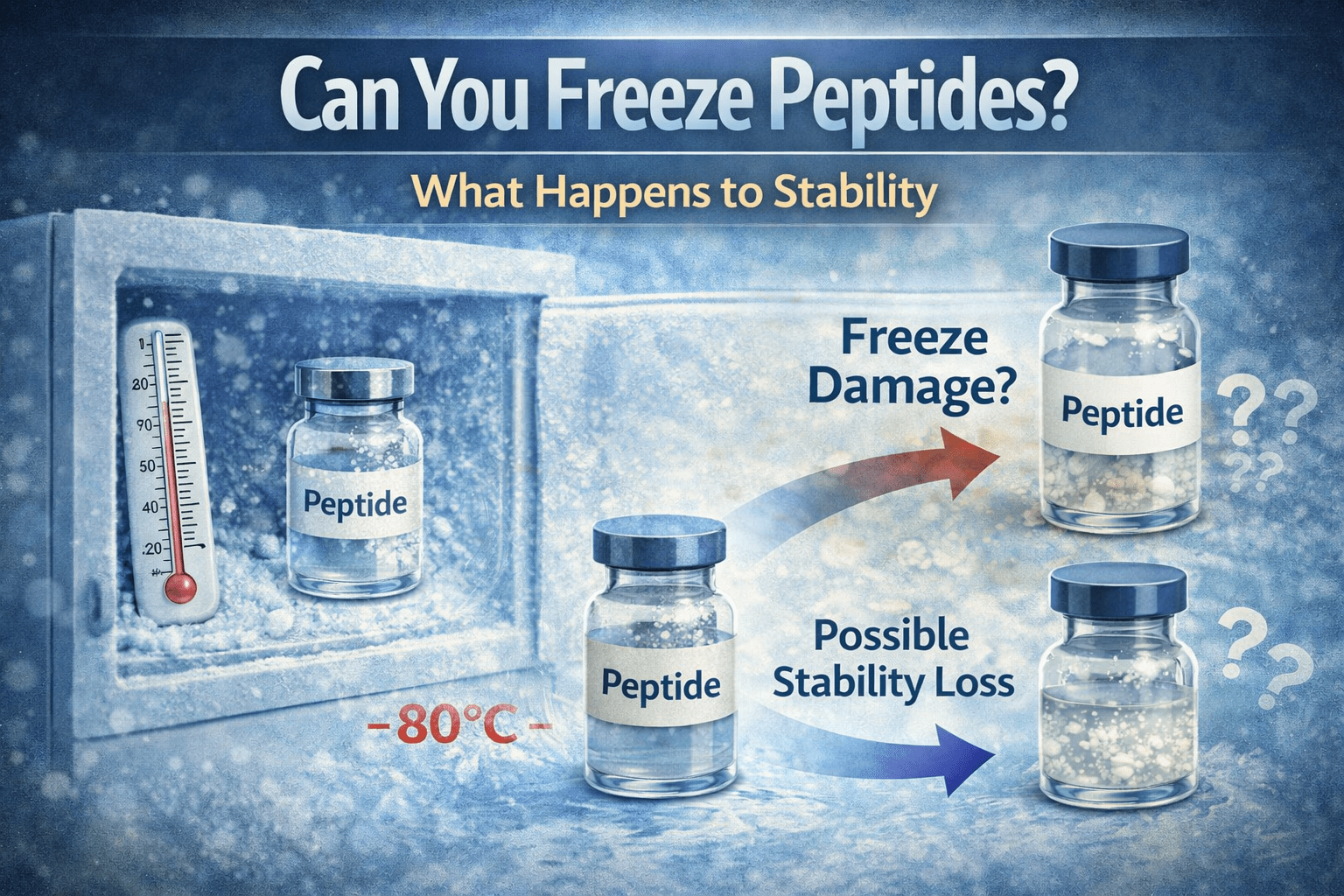
Freezing is widely used to preserve biological materials, so it’s natural to assume that it would help extend the life of reconstituted peptides. In reality, the situation is more nuanced.
While low temperatures can slow chemical degradation, freezing introduces physical and chemical stresses that can alter peptide structure and behaviour. For researchers, this creates a trade-off: reduced reaction rates on one hand, but potential instability on the other.
Understanding how peptides respond to freezing is key to maintaining consistency and avoiding subtle changes that can affect experimental outcomes.
Are Peptides Meant to Be Frozen?
In their lyophilised form, peptides are already optimised for stability. Removing water significantly reduces molecular mobility, limiting degradation pathways such as hydrolysis and oxidation (Carpenter et al., 1997).
Because of this, freezing lyophilised peptides is generally unnecessary. Standard refrigerated storage is typically sufficient to maintain integrity over time.
The question becomes more relevant once peptides are reconstituted and returned to an aqueous environment.
What Happens During Freezing
When a peptide solution is frozen, the solvent—typically water—begins to crystallise. This process does not occur uniformly.
As ice forms, dissolved substances—including the peptide—are excluded from the solid phase and become concentrated in the remaining liquid microenvironments. This phenomenon, known as freeze concentration, can significantly alter local conditions such as pH and ionic strength (Chang et al., 1996).
At the same time, the formation of ice crystals can exert mechanical stress on peptide structures. This is particularly relevant for larger or more complex peptides, where conformational stability is more sensitive to environmental changes.
Together, these effects mean that freezing is not simply a pause in activity—it is an active process that can influence peptide stability.
The Impact of Freeze–Thaw Cycles
The most significant risk associated with freezing peptides is not a single freeze event, but repeated freeze–thaw cycles.
Each cycle introduces:
- Structural stress from ice formation and melting
- Fluctuations in solute concentration
- Repeated shifts in pH and microenvironment
Over time, this can promote aggregation, partial unfolding, or loss of biological activity (Wang, 2000).
Even when no visible changes occur, these effects can reduce consistency across experiments.
Does Freezing Improve Stability?
Freezing does slow down many chemical degradation pathways by reducing molecular motion. However, this benefit must be balanced against the physical stresses introduced during the freezing process.
In peptide and protein systems, it is well established that freezing can both stabilise and destabilise, depending on the formulation and conditions used (Anchordoquy & Carpenter, 1996).
For most research peptides, freezing is not a guaranteed method of preservation unless the process has been specifically optimised and validated.
When Freezing May Be Used
In controlled research environments, freezing is sometimes used as part of a structured storage strategy.
One common approach is aliquoting. A freshly reconstituted peptide is divided into smaller volumes and frozen individually. Each aliquot is then thawed once and used immediately, avoiding repeated freeze–thaw exposure.
This approach can reduce variability, but it still depends on:
- The peptide’s structural stability
- The freezing rate
- Storage duration
- Thawing conditions
Without control over these variables, outcomes may be inconsistent.
Why Some Peptides Are More Sensitive
Peptide stability during freezing is highly dependent on molecular characteristics.
Sequences that are prone to aggregation, contain oxidation-sensitive residues, or rely on specific conformations are generally more vulnerable. Larger peptides and those with complex folding behaviour tend to be more affected than shorter, simpler chains.
For example, peptides involved in endocrine signalling—such as GHRH analogues or IGF-related compounds—may be more sensitive to environmental stress than smaller secretagogues.
This variability makes it difficult to apply a single rule across all peptides.
Storage Alternatives to Freezing
For most research applications, freezing is not required.
Refrigeration is widely used to slow degradation after reconstitution, providing a balance between stability and structural preservation. Combined with careful handling and limited storage duration, this approach tends to produce more consistent results.
Minimising time in solution remains one of the most reliable ways to preserve peptide activity.
👉 See also:
Recognising Freeze-Related Instability
Changes caused by freezing are not always immediately visible.
In some cases, solutions may appear cloudy or contain particulates, suggesting aggregation. In others, the only indication is a reduced or inconsistent response during research.
Because these effects can be subtle, controlling storage conditions proactively is more reliable than attempting to identify degradation after the fact.
🔬 Why Peptide Quality Still Matters
The way a peptide responds to freezing is influenced not only by handling, but also by its initial quality.
High-purity, well-characterised peptides are more likely to behave predictably under different storage conditions. Poor-quality material may show instability regardless of how carefully it is handled.
At DL Peptides, compounds are supplied in lyophilised form and tested to ensure consistency across research applications.
👉 Explore Research-Grade Peptides
If your research depends on stability and reproducibility, both sourcing and handling matter.
- 👉 View Tesamorelin (Research Use Only)
- 👉 Explore CJC-1295, Ipamorelin & IGF-1
- 👉 Browse the full D&L Peptides catalogue
Final Thoughts
Freezing peptides is not inherently harmful, but it is not universally beneficial either.
While low temperatures can slow degradation, the freezing process introduces structural and chemical stresses that can affect stability—particularly when repeated freeze–thaw cycles are involved.
For most research applications, careful reconstitution, controlled storage, and minimising time in solution remain more reliable strategies for maintaining consistency.
Frequently Asked Questions
Can peptides be frozen after reconstitution?
Yes, but freezing can introduce structural stress and is not always recommended unless properly controlled.
What is freeze concentration in peptides?
Freeze concentration refers to the increase in solute concentration in unfrozen regions during freezing, which can alter pH and stability.
Are freeze–thaw cycles harmful to peptides?
Yes. Repeated cycles can promote aggregation and reduce biological activity.
Is freezing better than refrigeration?
Not necessarily. Refrigeration is often more predictable for short-term storage after reconstitution.
Do all peptides respond the same to freezing?
No. Stability depends on peptide structure, size, and sensitivity to environmental stress.
References
- Carpenter, J. F., Pikal, M. J., Chang, B. S., & Randolph, T. W. (1997). Rational design of stable lyophilized protein formulations. Pharmaceutical Biotechnology.
- Chang, B. S., Kendrick, B. S., & Carpenter, J. F. (1996). Surface-induced denaturation of proteins during freezing and its inhibition by surfactants. Journal of Pharmaceutical Sciences.
- Anchordoquy, T. J., & Carpenter, J. F. (1996). Polymers protect lactate dehydrogenase during freeze-drying. Journal of Pharmaceutical Sciences.
- Wang, W. (2000). Lyophilization and development of solid protein pharmaceuticals. International Journal of Pharmaceutics.